
Water damage help, 24 hours a day
Los Angeles Water Damage
What it costs, what your policy actually covers, and the deadlines your insurer has to meet.
Water damage help, 24 hours a day
What it costs, what your policy actually covers, and the deadlines your insurer has to meet.
Water damage can happen to any building, and what decides how bad it gets is almost never the size of the leak. It is how fast the drying starts. Growth can begin on wet material inside roughly 24 to 48 hours, so the difference between a two-day job and a two-week one is usually measured in hours at the front end.
We handle water damage restoration in Los Angeles for any home or business across the county: water removal, water extraction, drying, damaged-material removal, and the rebuild afterward. As a water damage restoration company we also explain the claims process, because in California the rules around that are far more favourable to you than most people realise.
What you do before anyone arrives has more effect on the final invoice than almost anything that happens later.
Shut off the fixture or the main. Acting in the first hour does more to minimize damage than anything later. If the source of the water is not obvious, close the main anyway. Everything else waits until the supply is off.
If water is anywhere near outlets, panels, or ceiling fixtures, cut power to those circuits from the breaker, and only if you can reach it safely and dry.
Before you move a single item. Wide shots and close shots, with timestamps. This is the evidence your claim rests on and it cannot be recreated later.
Lift furniture onto blocks or foil, pull up loose rugs, and move anything absorbent out. Every hour a wooden leg sits in water is staining you cannot undo.
Addressing water damage starts with notifying your insurance company promptly. Most policies require it, and California starts its clock on them from the moment they receive notice.
Damaged material is proof. Bag it, set it aside, photograph it. Adjusters routinely question losses where the evidence went into a skip on day one.
One thing worth knowing before you decide how much to tackle yourself: not all water is the same. The industry sorts it into three categories, and it dictates what can be saved.
| Category | Source | What it means |
|---|---|---|
| Category 1, clean | Supply line, water heater, sink overflow | Most materials are salvageable if drying starts fast |
| Category 2, grey | Washing machine, dishwasher, toilet overflow without solids | Porous materials usually removed; cleaning required |
| Category 3, black | Sewage, ground surface water, outside flooding | Porous materials removed, containment and sewage cleanup needed |
Categories escalate with time. Clean water sitting for a few days becomes contaminated, which is another reason delay costs more than it saves.
Very few companies in this market publish numbers. Here is what the work generally runs locally, so you can judge an estimate before it arrives.
Types of water damage differ enough that a single average figure is useless. Two things drive the number: how much water there is, and how much material has to come out rather than be dried in place. Mitigation, meaning the urgent response and drying, is normally billed separately from the reconstruction that puts the building back together. Understanding that split matters, because insurers usually treat them as distinct parts of a claim.
| Scope | What it involves | Typical range |
|---|---|---|
| Small clean-water event, one room | Extraction, air movers and dehumidifiers, three to five days of monitoring | $1,000 to $3,000 |
| Multiple rooms, clean water | Larger pumps, more units, partial material removal | $3,000 to $8,000 |
| Grey water event | Removal of porous materials, cleaning, antimicrobial treatment, drying | $4,000 to $12,000 |
| Category 3 or sewage | Containment, full removal of affected porous material, disinfection | $7,000 to $25,000+ |
| Whole-floor or structural | Subfloor and framing involvement, extended drying, full rebuild | $15,000 to $50,000+ |
| After-hours extraction only | After-hours call-out, standing water removed, equipment set | $500 to $1,500 |
Ranges reflect typical Southern California pricing and are for orientation only. Repair costs to rebuild finishes are quoted separately from mitigation. Your actual figure comes from an inspection of the property.
This is the part nobody in this industry explains, and it is the most useful thing on this page.
California's Fair Claims Settlement Practices Regulations put binding deadlines on your insurer. These are not courtesies. They are requirements under Title 10 of the California Code of Regulations, and missing them is evidence of bad faith.
| Your insurer must | Deadline |
|---|---|
| Acknowledge your claim and send forms and instructions | 15 calendar days from notice |
| Begin investigating | 15 calendar days from notice |
| Respond to communications from you | 15 calendar days |
| Accept or deny the claim after proof of claim | 40 calendar days |
| Pay the undisputed portion once accepted | 30 calendar days |
| Explain any denial | In writing, with all reasons stated |
If more time is needed, the insurer has to tell you in writing why, before the 40 days expire, and keep updating you every 30 days after that. An adjuster who has gone quiet for six weeks with no written extension is out of compliance, and saying so politely and in writing changes the tone of a claim quickly.
Under section 2695.9(b), no insurer may require you to have the property repaired by a specific individual or entity. Preferred-vendor programs are a suggestion, not an instruction, and you are entitled to be told in writing that you may select your own.
Where an insurer recommends a vendor and you accept, the regulations require the insurer to see the property restored to no less than its condition before the loss, to accepted trade standards, at no additional cost to you.
What is usually covered: sudden and accidental events. A burst pipe, a failed supply line, an appliance hose letting go, a water heater rupturing. What is usually excluded: gradual seepage, long-term leaks that went unaddressed, deferred maintenance, and flooding from outside the building, which requires a separate policy. The word your policy will turn on is "sudden," which is why documenting when you first noticed the problem matters so much.
This is general information, not legal or insurance advice. Read your own policy and speak with your carrier or the California Department of Insurance about your specific situation.
Adjusters are not adversaries, but they are working from a script and their notes become the claim file. A few habits protect you without being obstructive.
Follow every phone call with a short email summarising what was agreed. A paper trail is the single most effective thing a policyholder can create.
"It has probably been leaking a while" is an answer that can move a claim from sudden to gradual. If you do not know, say you do not know.
An early number is an opening position, not a valuation. You are entitled to compare it against an independent estimate before agreeing to anything.
Volunteering that you had been meaning to fix something gives the file a reason to deny. Answer what is asked, accurately, and no more.
Reasons stated in full. A verbal denial is not a denial, and a written one gives you something concrete to challenge.
Date, time, who you spoke to, what was said. It costs nothing and it is what turns a dispute into a documented timeline.
If the claims process genuinely stalls, the California Department of Insurance takes consumer complaints, and that route exists precisely for the situations where the deadlines above are being ignored.
Our restoration services cover the path from the first call through drying and back to a finished space.
Full response for leaks, burst pipes, appliance failures, and other water intrusion.
Learn more →The emergency phase: stopping the spread, extraction, and getting the drying system running.
Learn more →Removal of ruined material, cleaning, sanitising, and preparing affected areas for drying.
Learn more →Rebuilding what came out: drywall, flooring, cabinetry, paint, and finish work.
Learn more →Larger-volume and contaminated-water events, including storm water and sewage backups.
Learn more →Call-outs at any hour, because the cost of this work is decided by how fast it starts.
Learn more →Knowing the sequence makes it far easier to tell a thorough estimate from a thin one.
Advanced moisture detection tools, meters and thermal imaging, establish the extent of the damage and locate the water leak feeding it. Water travels along framing and under flooring, so the wet area is nearly always larger than the visible one.
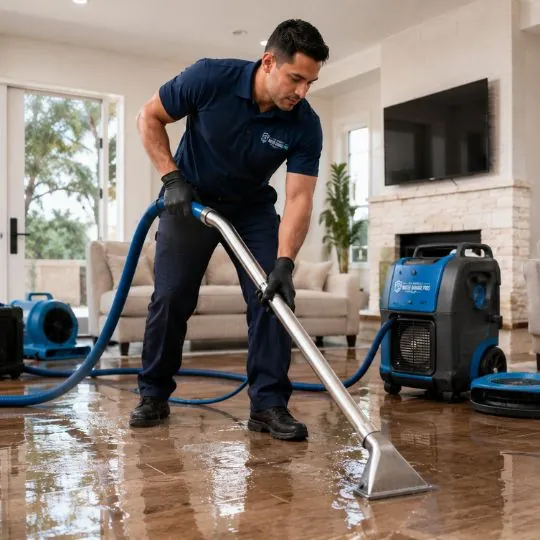
Truck-mounted or portable units remove water quickly and remove excess water before it spreads. Every gallon taken out mechanically is a gallon the dehumidifiers do not have to pull out of the air over days.
Leaving saturated material in place invites a mold infestation, mold damage and structural damage later, so wet insulation, carpet pad, and swollen baseboard come out. Drywall gets cut above the water line. Saturated porous material will not dry in place on any useful timescale.
Dehumidifiers and air movers are positioned by calculation, not by guess, and the number reflects the affected volume and the class of loss. This is where dehumidification does the real work.
Readings are taken and logged each day until materials hit a documented target. Drying typically runs three to five days. Equipment pulled at 24 hours leaves moisture in the assembly, which is how you prevent mold growth rather than merely delay it.
Once dry, the rebuild starts to restore your property: drywall, flooring, trim, paint. This is normally a separate line item, and separating it is a good sign rather than a bad one.
Ask for the daily moisture log. It is the document that proves drying was finished properly rather than abandoned when the room stopped feeling damp, and it matters if you ever need to show your insurer the work was done to standard.
This is a dry climate with a surprising amount of water damage, and the causes here are specific rather than seasonal. When damage occurs here it is usually one of the six below.
Across the city, large parts of the distribution network are decades old and some segments are over a century old. When a main lets go, the flooding is sudden, fast, and affects whole blocks rather than one building.
Buildings from the 1920s through the 1960s often retain original supply lines. These fail as pinholes inside walls, releasing small volumes continuously, which is worse for mold growth and structural decay than one obvious burst.
In post-war slab-on-grade construction, a failed line under the concrete shows as a warm floor, a rising bill, or lifting flooring rather than as visible water. Hidden water like this often runs for months, and water hiding under a slab is the single hardest kind to find without instruments.
In pre-war multi-unit buildings, a leak in a vertical stack surfaces in a different unit from the one containing the defect. The loss lands on a neighbour who did nothing wrong.
A long dry season leaves a roof or flashing defect entirely undetected, then a single heavy storm reveals it. Flat and low-slope roofs across the city are particularly unforgiving.
Properties cut into a slope take groundwater against foundation walls, and subterranean garages flood from the outside in. Both worsen sharply after burn-scar runoff upslope.
The water main case is worth a note of its own. Where a break originates in the public distribution system, the responsible utility may have its own property damage claim process, which is separate from your homeowners policy. If your loss came from a street-side break rather than your own plumbing, ask about that route before assuming your own insurer is the only option.
We coordinate water restoration for residential and commercial properties: rapid response, extraction, drying, cleaning, and the rebuild afterward. The aim is always to restore your home or business rather than to over-scope it. Where a job needs a trade we are not the right firm for, we say so and point you to restoration professionals who hold it. That is how the restoration industry ought to work, and property restoration is a wider field than any one firm covers.
Emergency restoration and extraction, structural drying, cleanup and sanitising, mold prevention, and reconstruction. Both residential water damage and commercial losses.
Fire damage, including fire and smoke damage, plus specialist document restoration and electronics restoration, and large-scale disaster restoration projects are separate disciplines with their own equipment and certifications.
One credential note. In California a state licence is required for construction work of $500 or more, issued by the Contractors State License Board. Any firm doing construction work on your property should have a CSLB number you can verify in about a minute, alongside liability cover and workers compensation. Industry certifications are useful but they are issued by trade bodies, not the state. Ask for the licence number first.
Across Greater Los Angeles we work with homeowners, renters, landlords, property managers, and businesses across the county, including Hollywood, West Hollywood, Beverly Hills, Santa Monica, Culver City, Burbank, Glendale, Pasadena, and Inglewood. Building age, plumbing, and drainage vary enormously between a Santa Monica apartment and a Pasadena craftsman, so each property in Los Angeles CA gets assessed on its own conditions. Emergency water damage in Hollywood is rarely the same job as water damage in Los Angeles hillside homes. If you have searched for water damage Los Angeles and found ten identical pages, this is the difference.
Ours is a service-area model, so the team comes to you rather than the other way round. Whatever your restoration needs, from a single wet closet to a whole flooded floor, describe what is happening and we will tell you honestly whether it needs a crew or a fan. Restoration solutions here are matched to the loss, not to a package.
See all service areas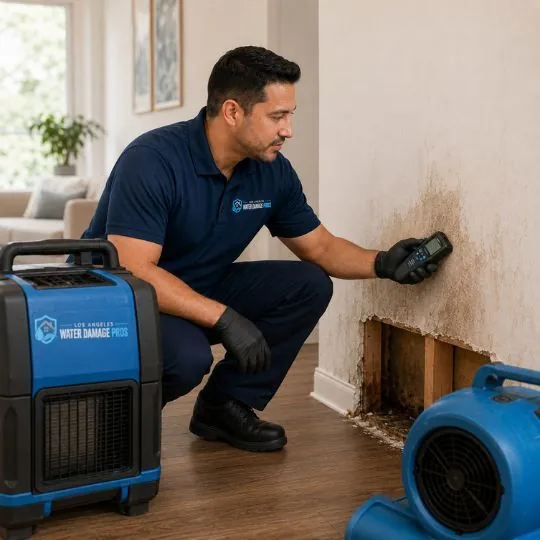
The best water damage outcome is decided in the first day, not the second week. That is what Los Angeles water damage restoration should mean in practice. We prioritise getting extraction equipment and dryers on site over paperwork that can wait until morning.
Professional restoration should include this. The deadlines your insurer must meet, and the fact that you choose who does the work. Most people are never told either.
We can work directly with your insurance adjuster where that helps. Daily moisture readings logged against a target, photographs at each stage, and a record you can hand to an adjuster without apology.
Expert water assessment sometimes concludes that a wet patch needs a fan and a week of patience rather than a crew, and we will tell you that. Small problems should stay small projects.
Our restoration specialists know pre-war plaster, galvanized supply lines, hillside slabs, subterranean garages, and rent-stabilised apartments each behave differently.
What was found, what it means, what the options are, and where the limits of the work sit, without jargon or pressure.
A small clean-water event in one room commonly runs $1,000 to $3,000 for extraction and drying. Multiple rooms typically fall between $3,000 and $8,000. Grey water pushes toward $4,000 to $12,000, and Category 3 or sewage events start around $7,000 and can pass $25,000. Reconstruction to rebuild finishes is quoted separately from the mitigation work.
Usually yes for sudden and accidental events such as a burst pipe, a failed appliance hose, or a ruptured water heater. Usually no for gradual seepage, long-term leaks that went unaddressed, deferred maintenance, or flooding from outside the building, which needs separate flood insurance. The distinction turns on the word sudden, which is why the date you first noticed the problem matters.
Within about 24 to 48 hours for drying to make the difference between a manageable job and a major one. Mold growth can establish on wet material inside that window, and water categories escalate with time, so clean water left standing for several days becomes contaminated. The urgency is on extraction and drying; the repairs can wait.
Under the Fair Claims Settlement Practices Regulations, your insurer must acknowledge the claim, provide forms, and begin investigating within 15 calendar days of notice, respond to your communications within 15 days, accept or deny within 40 calendar days of receiving proof of claim, and pay undisputed amounts within 30 days. Denials must be in writing with all reasons stated.
No. California regulations state plainly that no insurer shall require you to have the property repaired by a specific individual or entity. A preferred-vendor programme is a recommendation, and you are entitled to be informed in writing of your right to choose. If you do accept their recommendation, the insurer is then responsible for seeing the property restored to its pre-loss condition at no extra cost to you.
Avoid guessing. Do not speculate that something had probably been leaking for a while, because that can move a claim from sudden to gradual. Do not volunteer that you had been meaning to fix something. Do not accept a settlement figure on the spot before comparing it with an independent estimate. Answer what is asked, accurately, and follow every call with a short email summarising what was said.
The most common reasons are that the cause was ruled gradual rather than sudden, that the loss traces to deferred maintenance, that it was flooding from outside and therefore excluded, or that notice was given late. Poor documentation is the other big one, particularly where damaged material was thrown out before it could be inspected. Ask for the denial in writing with the reasons stated in full.
Usually three to five days for a typical residential loss, longer where hardwood, plaster, or dense assemblies are involved. The endpoint is a documented moisture content verified by meter, not a fixed number of days. Ask for the daily readings log, because that record is what demonstrates the job was finished to standard.
For a small clean-water spill caught immediately, often yes. Extract standing water, remove wet rugs, run fans and a dehumidifier, and check again over the next two days. Where it fails is anything that reached wall cavities, insulation, or subfloor, because household fans move air across surfaces rather than through assemblies. If your baseboards are wet, the wall is wet.
Often yes, if the affected area is limited and contained. Expect noise, equipment running continuously, and higher temperatures, since drying equipment generates a lot of heat. Staying elsewhere makes more sense when the loss involves the only bathroom or kitchen, when the water was contaminated, or when a large part of the floor area has been opened up.
Properly repaired and documented damage generally has limited effect, and a clean paper trail is what reassures a buyer. Unrepaired damage, or repairs with no documentation, is what costs you at closing, because a buyer has to assume the worst. In California, known material defects affecting value must be disclosed on the transfer disclosure statement, so a good record works in your favour twice.
Mitigation is the emergency phase: stopping the water, extraction, setting equipment, and removing unsalvageable material to prevent additional damage. Restoration is putting the building back, meaning drywall, flooring, paint, and cabinetry. They are separately scoped and separately priced, and insurers commonly treat them as distinct components of a claim.
It depends on the material and how long it was wet. Plywood subfloor that was wet briefly with clean water can often be dried in place and saved. Particle board or oriented strand board that absorbed water and swelled generally cannot, because it loses structural integrity and does not recover. Any subfloor exposed to Category 3 water comes out regardless.
That changes who you claim against. Where a break originates in the public distribution system, the responsible utility typically has its own damage claim process, separate from your homeowners policy. Document the source carefully, keep everything, and ask the utility about filing directly. You may end up pursuing both routes, which is why the paperwork matters even more than usual.
In California a state licence is required for construction work of $500 or more, so effectively yes for anything beyond the smallest repair. Verify the number with the Contractors State License Board and confirm liability cover and workers compensation. Industry certifications from trade bodies are useful context, but the state licence is the credential that carries legal weight.
Not sure whether what you are looking at needs a crew or a fan? Start with an evaluation and a clear conversation about the property. One quick call is usually all it takes.
Quick, simple, and no obligation