
Water damage help
Water Damage Service
Call Los Angeles Water Damage for fast water damage help today.
Water damage help
Call Los Angeles Water Damage for fast water damage help today.
Water damage can start with a small leak, a burst pipe, an overflowing appliance, a broken water heater, storm flooding, or water intrusion through a roof or wall. No matter how it begins, the most important step is acting quickly. Water can move through flooring, baseboards, drywall, cabinets, and lower wall cavities before the surface looks seriously damaged.
Los Angeles Water Damage helps property owners stabilize the problem, inspect affected areas, remove excess water, dry wet materials, and plan the right cleanup or repair. Call us if you need emergency water damage service in Los Angeles, CA.
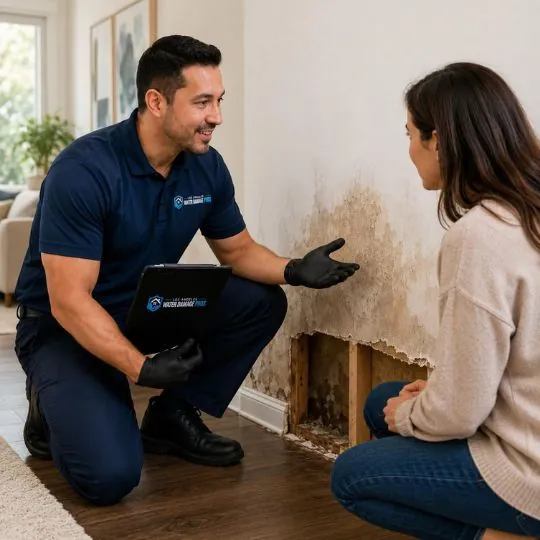
Our water damage service starts with finding the source of the water and understanding the extent of the damage. If water is still entering the building, stopping or controlling that source is the priority. From there, our team checks visible and hidden moisture, maps affected areas, and explains what needs immediate attention. When standing water is present, we extract standing water with professional extraction equipment. We then set up drying equipment, air movers, and dehumidification as needed to pull moisture from the structure. This step is critical because a room can look dry while hidden water remains behind walls, under flooring, or inside trim. Once the building is dry, cleanup and repair planning begin. Depending on the situation, that may include removing damaged materials, sanitizing surfaces, odor control, drywall repair, flooring repair, or coordination with your insurance company. The goal is to restore your property safely and reduce the risk of mold growth and structural damage.
We inspect the source of the water, visible damage, hidden moisture, and materials that may need drying or removal.
When there is standing water, we use extraction equipment to remove water quickly and reduce additional damage.
We use drying equipment, dehumidifiers and air movers to dry the structure and help prevent mold growth.
We clean affected areas, remove unsalvageable materials, and help return the property to a safe condition.
We explain repair needs clearly, from small drywall patches to larger property restoration work.
Two losses of the same square footage can need very different amounts of equipment. Here is what determines that, and what the answer means for your invoice.
Alongside the three water categories, the industry sorts a loss into four classes based on how much material got wet and how hard it will be to dry. The class drives how many air movers and dehumidifiers the job needs, which drives the equipment line on your estimate. A contractor who cannot tell you the class has not calculated the drying system; they have guessed at it.
| Class | What it describes | Drying difficulty |
|---|---|---|
| Class 1 | Minimal absorption, small part of the room, mostly low-porosity material | Fastest, least equipment |
| Class 2 | Whole room affected, water wicked up walls under 24 inches, carpet and pad wet | Moderate |
| Class 3 | Water came from above, saturating ceilings, walls, insulation, and subfloor | High, most equipment |
| Class 4 | Low-evaporation materials involved: hardwood, plaster, concrete, stone | Specialty drying, longest duration |
Class 4 is worth flagging because it is common in Los Angeles. Pre-war buildings with plaster over lath, and any property with hardwood or stone, hold moisture in ways drywall does not. Those need specialty methods such as mat systems or injection drying rather than simply more fans, and a job quoted as though it were Class 2 will stall halfway through.
What survives comes down to porosity and time. Non-porous surfaces, meaning tile, metal, glass, and sealed concrete, clean up. Semi-porous materials such as solid wood framing and hardwood can often be dried in place if the response was fast. Porous materials, meaning carpet pad, batt insulation, particle board, and ceiling tile, generally come out, because they absorb water throughout and will not release it on any useful timescale.
Finding the boundary is the other half of the job. Water travels along framing, wicks up drywall, and moves under flooring, so the wet area is nearly always bigger than the visible one. Thermal imaging shows temperature differences where evaporation is happening, and probe meters confirm it. A scope built only on what you can see is the cheaper estimate for a reason.
| Service | Estimated Cost | Average |
|---|---|---|
| Basic moisture inspection | $150 to $450 | $300 |
| Water extraction | $500 to $2,500 | $1,200 |
| Drying and dehumidification | $800 to $4,500 | $2,200 |
| Water damage cleanup | $1,000 to $6,000 | $3,000 |
| Repairs after drying | $750 to $10,000 plus | $3,500 |
Actual pricing depends on the source of the water, square footage, materials affected, contamination level, drying time, and repair scope. Call us for a project-specific estimate.
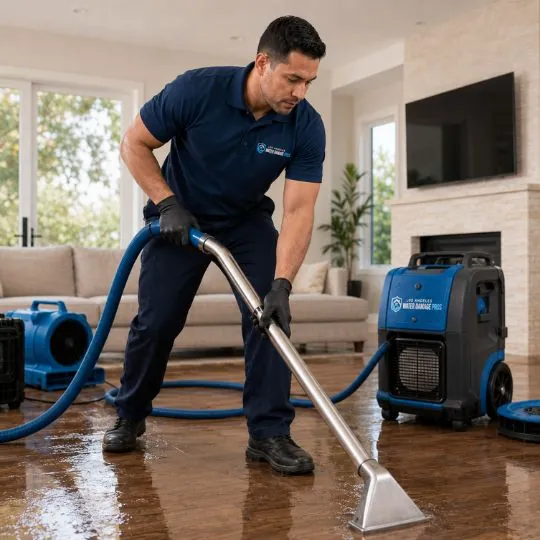
We focus on stopping the spread, removing water, and getting the drying process started before damage worsens.
We look for hidden water, not just visible puddles, so affected areas are handled more completely.
We explain what can dry, what should be removed, and what repair costs may depend on.
Our team serves homes and businesses throughout Los Angeles and surrounding communities.
Inspection and moisture mapping to establish the extent, extraction of standing water, removal of materials that cannot be saved, placement of drying equipment sized to the class of loss, daily monitoring until documented targets are met, and then reconstruction of what came out. The first five are mitigation; the last is usually a separate scope and a separate price.
Plumbing supply lines and appliance connections account for the largest share, particularly braided washing machine hoses, dishwasher supply lines, water heaters, and toilet supply valves. In Los Angeles specifically, ageing galvanized pipe in pre-war buildings and under-slab line failures in post-war construction are both disproportionately represented.
Material that has dried to a documented target and shows no distortion is generally fine. Permanent damage looks like warping that does not flatten, delamination in engineered flooring or particle board, staining that persists after drying, crumbling drywall, and any softness in structural wood. If a material has changed shape rather than just colour, drying will not bring it back.
Thermal imaging first, because evaporating water cools a surface and shows as a temperature difference. That indicates where to probe. A pin or pinless meter then confirms the actual moisture content in the material. Neither works alone: thermal imaging finds candidates, meters confirm them, and a small inspection hole settles anything still ambiguous.
No. Drywall wet with clean water for a short period can often be dried in place, especially if the insulation behind it is intact and the wet zone is limited. Replacement becomes necessary where the board has lost integrity, where water was Category 2 or 3, where insulation behind it is saturated, or where it stayed wet long enough for growth to begin.
Structural rot takes weeks to months of sustained moisture, but the practical problems arrive much sooner. Engineered wood and laminate can swell within a day. Subfloor adhesives fail early. Growth can begin within 24 to 48 hours. So while rot is a slow process, the decisions about a floor need to be made in the first couple of days.
Tile itself is unaffected, but the substrate underneath may not be. Water reaches it through grout and at edges, then sits with nowhere to evaporate because tile is effectively a vapour barrier. The signs are hollow-sounding tiles, loose grout, and a persistent musty smell. Often the tile has to be lifted in the affected area to dry what is beneath it.
Category describes how contaminated the water is, from clean supply water through to sewage, and it decides what can be saved. Class describes how much material got wet and how hard it will be to dry, and it decides how much equipment the job needs. A proposal should state both, because together they explain the price.
Need help with water damage in Los Angeles? Call Los Angeles Water Damage now.
Quick, simple, and no obligation
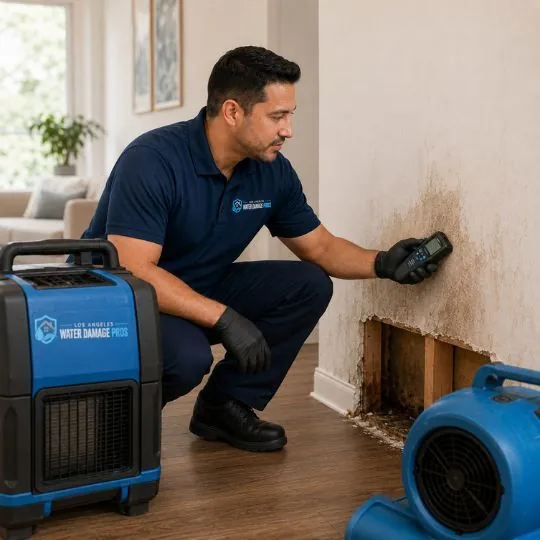
Call us and tell us what happened, where the water is coming from, and which areas are affected.
We check the source, moisture spread, safety concerns, and the types of water damage involved.
We remove water with extraction equipment and prepare the space for controlled drying.
We use air movers, dehumidification, and moisture checks to dry structural materials.
We clean the damaged areas and help plan repairs so the property can move toward pre-loss condition.