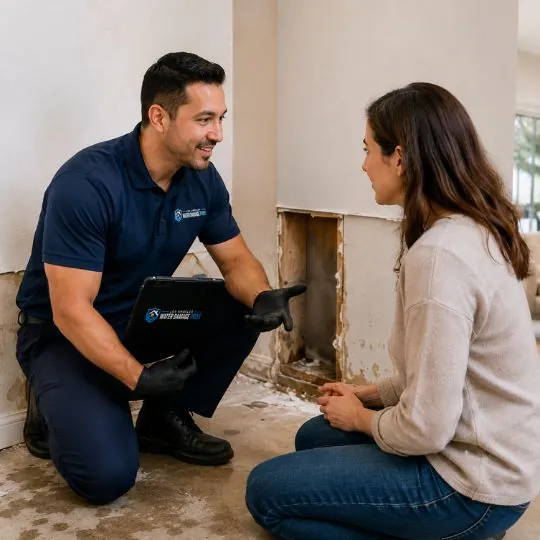
Glendale water damage service
Water Damage in Glendale
Call us for water damage service in Glendale.
Glendale water damage service
Call us for water damage service in Glendale.
Water damage in Glendale can happen in hillside homes, older buildings, apartments, offices, and retail spaces. Plumbing failures, roof leaks, drain backups, appliance overflows, and storm water can leave standing water and hidden moisture in walls, floors, and ceilings.
Los Angeles Water Damage serves Glendale with water damage restoration, water mitigation, cleanup, water extraction, drying, and repair planning. We help dry affected areas, reduce mold growth risk, and explain what needs to happen next. Call us for water damage service in Glendale.
Glendale runs from a flat urban core up into the Verdugo Mountains, and that vertical range is the defining factor. On a flat lot, water management is essentially about the first few feet around a building. On a hillside lot, water arrives from uphill, crosses the property, and concentrates wherever the grading sends it. Homes cut into a slope have earth pressing against an uphill wall, and after a wet week that wall takes sustained moisture whether or not anything has failed.
The seasonal pattern is pronounced. Long dry months leave a roof or flashing defect entirely undetected, then the first significant storm reveals it, frequently several storms after the damage actually started. Foothill properties also see concentrated runoff carrying debris that blocks drains and sends water toward buildings rather than away. Checking hillside drains, swales, and downspout outlets before the wet season prevents a large share of what we get called out for.
The housing is largely mid-century, with substantial 1940s to 1960s development in the flatter areas and older homes in neighbourhoods like Adams Hill and Rossmoyne. Original galvanized supply lines from that era are now failing as pinholes. Glendale is an independent city with its own building department and runs its own water and power utility, which is the relevant party if a loss traces to the service connection or a street main.
Earth against an uphill wall transfers moisture through the wet season. Runoff concentrates on the downhill side.
A defect that developed in August often first shows after the first real storm. Damage is usually older than the stain that reveals it.
Glendale operates its own water and power utility, so a main break or service-connection claim runs through the city rather than LADWP.
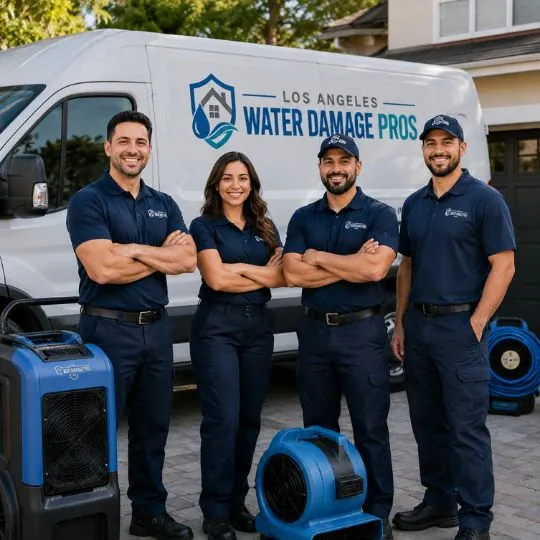
We understand the mix of homes, apartments, commercial spaces, and hillside properties in the area.
We use extraction and drying equipment to remove water and control moisture.
Fast drying and cleanup help reduce conditions that allow mold growth.
We explain the source, damage, drying plan, and repair needs clearly.
Because there is earth against it. A wall retaining soil takes moisture transfer and hydrostatic pressure continuously, and during the wet season the ground behind it stays saturated for weeks. If that wall encloses living space and was not built with waterproofing and drainage for that purpose, damp on the inside face is the predictable outcome rather than a failure.
In Glendale, the city's own water and power utility rather than LADWP. That distinction catches people out, because neighbouring areas are served by different providers. Photograph the source and the damage before anything is cleared, keep receipts, and ask the utility about their damage claim process, which is separate from your homeowners policy.
Usually because it was there earlier with nothing to reveal it. A roof or flashing defect that developed during the long dry season produces no visible symptom until enough water passes through. By the time a ceiling stains, the defect is often months old and the surrounding material has been wetting and partially drying repeatedly.
Hillside drains, swales, gutters, and downspout outlets, confirming water actually exits where it is meant to. On foothill properties these silt up gradually and give no warning until they overflow. Checking again after the first significant storm confirms they are carrying the volume. It is a short job that prevents a lot of damage.
This is a service-area business. We do not operate a staffed office in Glendale. For service in Glendale, call us.
Quick, simple, and no obligation