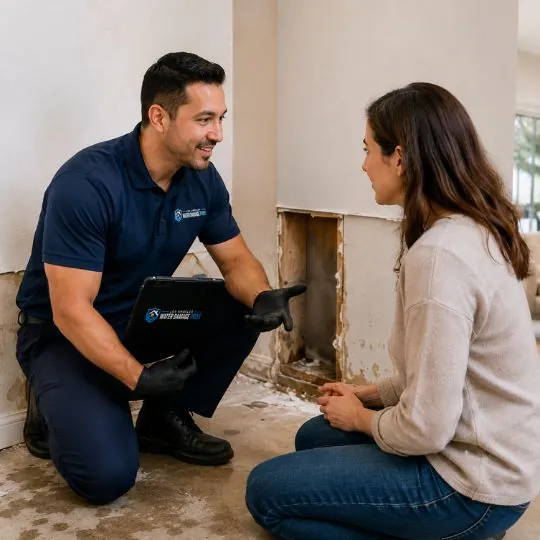
Local water damage help
Water Damage in Los Angeles
Call us for fast water damage service in Los Angeles.
Local water damage help
Call us for fast water damage service in Los Angeles.
Los Angeles properties face water damage from burst pipes, appliance leaks, roof leaks, hillside runoff, storm drains, aging plumbing, and sudden flooding. Whether you own a single-family home, manage an apartment building, or run a business in Los Angeles, fast water damage cleanup can make a major difference in repair costs and recovery time.
Los Angeles Water Damage serves Los Angeles with emergency water extraction, water mitigation, drying, cleanup, repair planning, and flood damage restoration. We help identify affected areas, remove standing water, dry hidden moisture, and document the damage. Call us for water damage help in Los Angeles today.
The City of Los Angeles covers close to 500 square miles and a century of construction, and where your building sits in that range determines what is most likely to have failed. Pre-war buildings across Hollywood, Mid-City, and the older eastside neighbourhoods commonly retain original galvanized supply lines. Those corrode from the inside and fail as pinholes rather than bursts, releasing small volumes continuously inside a wall, sometimes for months before anything shows on the surface.
Post-war neighbourhoods brought slab-on-grade construction, where supply lines run beneath the concrete. A slab leak announces itself as a warm patch on the floor, a water bill that climbed with no change in use, the sound of running water with everything off, or flooring that has started to lift. There is often no visible water at all, which is why these run so long.
Then there is the distribution network itself. Parts of the city's water mains are decades old and some segments are over a century old, and when one lets go the flooding is sudden and affects whole blocks rather than a single property. That matters for your claim: where the water originated in the public system rather than your plumbing, the Los Angeles Department of Water and Power has its own damage claim process, which is separate from your homeowners policy. Establish the source early, because it decides who you are dealing with.
Pinhole failures release small volumes continuously inside walls. Worse for the building than an obvious burst because nobody finds it for months.
A warm floor, a rising bill, or lifting flooring with no visible water. These commonly run for a long time before anyone investigates.
Where the break is in the street rather than your building, the utility has its own claim route. Document the source before anything gets cleaned up.
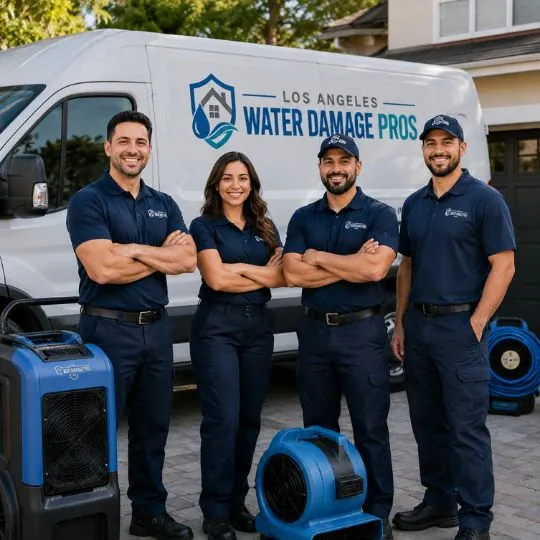
Our team is built around local service, from dense apartment buildings to hillside homes and commercial spaces.
We handle extraction, drying, dehumidification, cleanup, sanitation, and repair planning.
Water damage gets worse with time, so we move quickly when you call for help.
We explain what is wet, what needs removal, what can dry, and what repair steps may follow.
The usual signs are a warm patch on the floor if it is the hot line, a water bill that rose with no change in use, the sound of running water when everything is shut off, cracked or lifting flooring, and damp at the base of a wall. A plumber can pressure test and locate it, and that should happen before any drying work is scoped.
Probably the utility rather than your insurer. Where a break originates in the public distribution system, the Los Angeles Department of Water and Power runs its own damage claim process. Photograph the source and the damage before anything is moved, keep every receipt, and ask about filing directly. Some people end up pursuing both routes at once.
Original galvanized supply lines from the 1920s through the 1950s are now well past their service life. They corrode internally and fail as pinholes, which release a small amount of water continuously rather than flooding a room. The result is a wall cavity held at exactly the moisture level that supports growth, often for months before anyone notices.
For diagnosis, yes. Pre-war areas point toward galvanized supply failures and shared stacks in multi-unit buildings. Post-war tracts point toward slab leaks. Hillside properties add groundwater against foundation walls. Knowing which category your building falls into narrows the investigation considerably before anyone opens a wall.
This is a service-area business. We do not operate a staffed office in Los Angeles. For service in Los Angeles, call us.
Quick, simple, and no obligation